


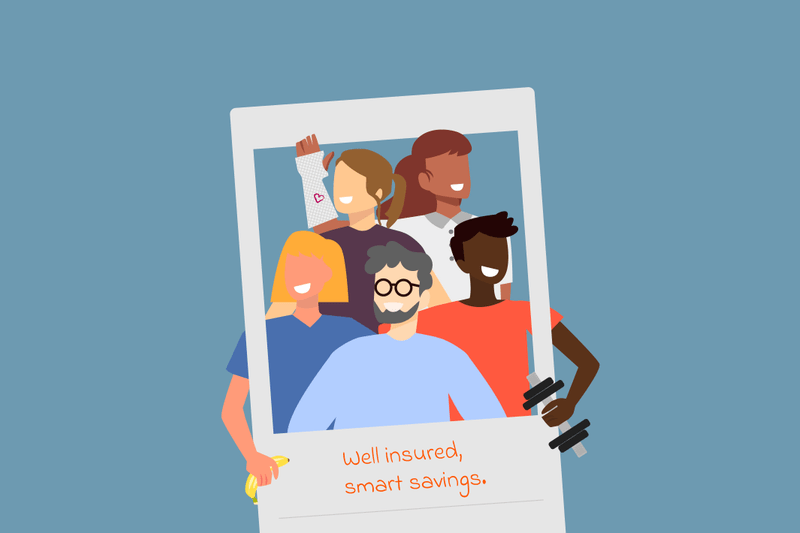
Attractive health insurance offers for you
Migros is committed to helping employees reduce their everyday living costs. That's why Migros Group employees benefit from attractive discounts and special conditions with selected health insurance providers.

Your Migros benefits
On this page, you will find selected health insurance offers that have been negotiated specifically for Migros Group employees. They help you support your health while saving money in everyday life.
The focus is on supplementary insurance plans with attractive value for money, contributions towards prevention and physical activity, and convenient switching and advisory services.
We’ve put together an overview of the different options so that you can quickly find the solution that best fits your lifestyle and budget.
Your benefits at a glance
- Exclusive Migros special conditions on supplementary insurance plans
- Contributions of up to CHF 300 towards gym memberships, glasses and more
- In some cases, supplementary insurance is available without a medical assessment (e.g. with KPT)
- Personal advice and support when switching insurance providers
How to take advantage of these offers
Interested? Please contact the respective insurance provider
You can find links to the offers in the boxes below.

KPT
Comprehensive coverage for just CHF 19.90
Migros Care360: No medical examination required. Available to everyone, regardless of age or gender. Get up to CHF 300 towards glasses or a gym membership as well as travel insurance – including for family members living in the same household.
CSS
Savings benefits near you
Receive a 7% to 9% discount on selected CSS supplementary insurance plans. Family members living in the same household also benefit from this offer.

Helsana
Digital benefits with rewards programme and 10% discount
Enjoy an exclusive 10% reduction on selected supplementary insurance (collective contract number KN30014898) and stay active. In addition, you can receive up to CHF 200 per year towards your gym membership.

AXA
Save more with the switching service
AXA takes care of switching you each year easily and conveniently to the lowest-cost basic health insurance option. With supplementary insurance from AXA, you can also receive up to CHF 300 per year towards your gym membership.
SWICA
Support for your leisure activities and health
Promote your wellbeing with support from SWICA. Benefit from attractive offers related to fitness and nutrition, as well as up to CHF 300 towards your next Migros Golf AG membership.
FAQ
Note
The information on this page is intended for general guidance only and does not replace individual advice. Binding information can be obtained directly from the respective health insurance provider.
Questions about Migros framework agreements with health insurance providers
How does Migros work with health insurance providers?
Migros does not offer health insurance itself. Instead, it has negotiated attractive framework agreements with several insurance providers that will take effect on 1 January 2027. These offers are available to Migros Group employees. The most suitable insurance depends on individual needs, which is why Migros does not recommend any specific health insurance company. Employees are responsible for reviewing the available offers and contacting the health insurance provider directly if interested.
What are the benefits for me as a Migros employee?
Thanks to the size of the Migros Group, we have been able to negotiate attractive conditions with leading health insurance providers. As a result, all employees can benefit from advantageous discounts on supplementary insurance plans.
Are the offers also available for minors or if you are insured under your parents’ policy?
Yes. In principle, apprentices as well as employees under the age of 18 can also benefit from the health insurers’ offers. In many cases, this also applies if you are insured under your parents’ health insurance policy.
The exact eligibility requirements and benefits may vary depending on the insurer and the offer. We therefore recommend that you contact the respective health insurer directly to obtain information about the conditions that apply to your situation.
Can the employee offers change? How long are they valid?
Health insurance providers may generally adjust their conditions annually (effective 1 January), for example due to economic, legal or regulatory changes. In such cases, insurance companies are required to inform their contractual partners accordingly.
Will my data be shared with Migros if I contact an insurance provider?
No. Any contact and contractual relationship is established directly between you and the insurance provider. No information is reported back to Migros.
How are health insurance costs billed?
Migros is not involved in the billing process. Premium payments and any related costs are handled directly between you and your health insurance provider.
In most cases, you can choose from various payment methods, such as payment slip (by post or email), eBill or direct debit (LSV).
What happens if I leave Migros or retire?
As a general rule, if you are no longer employed by Migros, you are no longer entitled to employee discounts. Please inform your insurance provider when you leave the Migros Group. Your insurance contract remains directly between you and the insurance provider.
Insurers such as KPT and Helsana also offer these special conditions to former Migros employees who are already retired. As supplementary insurance plans cannot be compared on a one-to-one basis, we recommend making use of the insurers’ advisory services or consulting the information available on their websites and in the FAQ.
Questions about basic and supplementary health insurance (HIA and IPA)
Is health insurance compulsory in Switzerland?
Yes. Basic health insurance is compulsory for everyone residing in Switzerland.
What's the difference between basic and supplementary insurance?
Basic insurance is required by law, and the benefits covered (e.g. treatment for illness and maternity) are essentially the same across all health insurers.
Differences in basic insurance mainly relate to premiums, services provided, claims and billing processes as well as insurance models.
Supplementary insurance is voluntary and covers additional benefits, such as contributions towards gym memberships, alternative medicine and semi-private or private hospital accommodation.
The offers available to Migros employees relate exclusively to supplementary insurance plans.
Which basic health insurance models are available?
Common models include:
- Standard model = free choice of doctor
- General practitioner model = you must visit your designated GP first
- HMO model = treatment through a healthcare centre or health maintenance organisation (HMO)
- Telmed = initial consultation either via telephone or digital medical advide
The models also differ in terms of cost.
What is the deductible in basic health insurance?
The deductible is the amount insured persons pay themselves each year before their health insurance provider begins covering costs. Deductible levels range from CHF 300 to CHF 2500.
What's the co-payment in basic health insurance?
After the deductible has been reached, insured persons generally pay 10% of further healthcare costs, up to a legally defined annual maximum.
How do I choose the right deductible?
A useful rule of thumb is:
- Higher deductible is suitable if you rarely visit a doctor have a low health risk
- Low deductibles are suitable if you require regular treatment or have higher healthcare expenses
Health insurance providers are happy to help determine the most suitable deductible for your situation.
When is supplementary insurance worthwhile?
Supplementary insurance can be worthwhile if you regularly use services that are not or only partially covered by basic insurance, such as gym memberships, glasses or contact lenses, alternative medicine, orthodontic treatment or for additional comfort during hospital stays.
Am I required to purchase supplementary insurance?
No. Supplementary insurance is not mandatory. However, Migros has negotiated attractive framework agreements for employees. These provide additional support for your health, everyday benefits and financial contributions towards items such as gym memberships and/or glasses or contact lenses. We encourage you to review the available offers. Health insurance providers can also answer any questions and assist you with a potential switch.
Can family members also benefit from the supplementary insurance offers?
There's no one-size-fits-all answer to this. It depends on the health insurance provider and the specific policy conditions. In general, family members can usually benefit from the offers if they live in the same household. For detailed information, please contact the relevant health insurance provider correctly.
Am I covered abroad?
This depends on the insurance provider and your personal insurance needs. Many insurance providers offer coverage for medical treatment abroad, although the scope of coverage varies from policy to policy. For detailed information, please contact the insurance provider directly.
Questions about switching provider
Can I change my health insurance provider?
Yes. In most cases, you can switch every year. For basic insurance, changing providers is generally straightforward, provided the legal notice periods are observed.
Can I switch my supplementary insurance independently from my basic insurance?
Yes. Basic and supplementary insurance may be held with different insurance companies.
What notice periods apply to basic and supplementary insurance?
Different rules apply in Switzerland:
- Basic insurance
You can generally terminate your basic health insurance at the end of the year (31 December). However, your cancellation notice must reach the insurer no later than 30 November of the current year (receipt date, not postmark date). For certain models (e.g. standard model with a high deductible), cancellation may also be possible effective 30 June. - Supplementary insurance
Notice periods vary depending on the provider and policy. Longer notice periods often apply
(e.g. three months before the end of the contract term). It is therefore advisable to plan a switch well in advance.
Insurance providers can inform you of the specific deadlines and may also assist with the cancellation process through a switching service.
More information about switching health insurance can also be found here (Federal Office of Public Health).
Does the new health insurance providers have to accept me, or can I be rejected?
For basic insurance, insurers cannot refuse applicants. For supplementary insurance, acceptance may depend on a medical assessment and its results (e.g. rejection due to pre-existing conditions).
Do I need to answer health-related questions when applying?
That depends on the insurance provider. Certain offers (such as KPT) may be available without a medical assessment. For detailed information, please contact the insurance provider directly.
What if I already have supplementary insurance?
This depends on your existing policy. In many cases, comparing available options can be worthwhile. Health insurance providers can advise you individually and help determine whether switching would be beneficial.
Should I take out the new health insurance before cancelling my current one?
The safest approach is to first arrange the new insurance policy and only then cancel your existing one within the applicable notice period. This helps avoid coverage gaps and administrative complications. Some insurance providers also provide switching services to support you throughout the process.
Who can help me with questions or with switching?
The insurance providers offer advice and, in some cases, switching services. You can find links to the relevant contact points on the information page. Please contact the insurance company or companies of your choice directly.